
N1 Mock test 1
July 2021 paper
Set aside 2 hours 48 minutes
Two timed sections in one sitting. Once a section ends you can't go back to it. Have headphones ready for the listening.
- Vocabulary, Grammar & Reading110 min · 69 questions
- Listening58 min · 34 questions
Vocabulary, Grammar & Reading 110 min · 69 questions
問題1漢字読み
_____の言葉の読み方として最もよいものを、1・2・3・4から一つ選びなさい。
-
1.今回の件については、大変遺憾に思っております。
Show answer
Answer: 2. いかん
遺憾'deeply regrettable', both kanji in on'yomi
今回の件については、大変遺憾に思っております。
With regard to this matter, I feel deep regret.
The set phrase 遺憾に思う means to regard something as deeply regrettable and is used in formal apologies. The clue 大変遺憾に思っております shows a formal expression of regret, not surprise or anger. Both kanji are read in on'yomi as イ and カン.
Remember
Learn 遺憾 as a fixed formal chunk meaning deep regret. Contrast the sound with 意外 meaning unexpected, and contrast 憾 with 感 as in 敏感.
Why not the others
Words
- 件matter, case
- 遺憾deeply regrettable
- 思っておりますhumbly think, feel
-
2.この門は常時閉鎖されている。
Show answer
Answer: 4. へいさ
閉鎖'closure, closed', both kanji in on'yomi
この門は常時閉鎖されている。
This gate is kept closed at all times.
閉鎖 means closure of a gate, road or facility. The clues 常時 meaning at all times and されている showing a resulting state point to a gate kept shut. The second kanji 鎖 is read サ in this compound, without く.
Remember
Keep pairs apart: 閉鎖 for a closed gate or road, and 閉塞 for a blocked pipe or state of deadlock.
Why not the others
Words
- 門gate
- 常時at all times
- 閉鎖closure
-
3.どんな時にも、周りへの心遣いを忘れてはいけない。
Show answer
Answer: 2. こころづかい
心遣い'consideration', 遣い with rendaku つ to づ
どんな時にも、周りへの心遣いを忘れてはいけない。
At all times, you must not forget to be considerate toward those around you.
心遣い means thoughtfulness or consideration for others. The clue 周りへの points to attention directed to people around you. The second part comes from 遣う and voices to づかい in this compound.
Remember
Remember the rendaku group 気遣い and 心遣い, both read づかい from 遣う.
Why not the others
Words
- 周りsurroundings, people around
- 心遣いconsideration, thoughtfulness
-
4.彼は顔を真っ赤にして憤った。
Show answer
Answer: 3. いきどおった
憤る'to be indignant', kun'yomi, ta-form 憤った
彼は顔を真っ赤にして憤った。
His face turned bright red with indignation.
憤る means to feel strong indignation or resentment. The clue 顔を真っ赤にして describes a face red with that emotion. In the ta-form, る changes to った, giving 憤った.
Remember
Group anger verbs by kanji: 憤る feel indignant, 怒鳴る shout, 罵る insult, 唸る groan.
Why not the others
Words
- 真っ赤(まっか)bright red
- 憤るto be indignant
-
5.貧富の差が大きくなっているようだ。
Show answer
Answer: 3. ひんぷ
貧富'rich and poor', on'yomi with フ changing to プ
貧富の差が大きくなっているようだ。
It seems that the gap between rich and poor is growing.
貧富 combines 貧 poor and 富 rich to mean poverty and wealth. The clue 差 meaning gap requires a pair of opposites. Both kanji use on'yomi, with 富 read プ after ン.
Remember
Contrast 貧乏 with voiced ビン and long vowel, against 貧富 and 貧困 with unvoiced ヒン.
Why not the others
Words
- 貧富rich and poor
- 差difference, gap
-
6.治癒するには1か月程度かかる。
Show answer
Answer: 1. ちゆ
治癒 (ちゆ)'healing, recovery', on'yomi ち + ゆ
治癒するには1か月程度かかる。
It will take about a month to heal completely.
治癒 means healing or full recovery from an illness or injury, which fits the clue 1か月程度かかる, to take about a month. It is read ちゆ, with on'yomi for both kanji, 治 as ち as in 治療 and 癒 as ゆ. The second mora is short ゆ, with no long vowel and no voicing.
Remember
Remember 治 as ち in cure words like 治療 and 治癒, but as じ in government words like 政治. 癒 is ユ, always short ゆ in 治癒 and 癒着.
Why not the others
Words
- 治癒healing, complete recovery
- 程度extent, about
- かかるto take time or money
問題2文脈規定
( )に入れるのに最もよいものを、1・2・3・4から一つ選びなさい。
-
7.上司は私の提案を( )した。
Show answer
Answer: 3. 却下
却下 (きゃっか)'rejection of a proposal', used as 提案を却下する
上司は私の提案を却下した。
My boss rejected my proposal.
The clue is 提案を, meaning proposal, plus した. 却下する means to turn down a proposal, application or appeal after consideration. It is the standard collocation 提案を却下する.
Remember
Learn 却下 with 提案, 申請, 上訴: it rejects paperwork and ideas. Learn 駆除 with pests, 除去 with stains, 脱却 with から for bad habits.
Why not the others
Words
- 上司boss, superior
- 提案proposal
- 却下rejection, dismissal
-
8.この子は好奇心が( )で、分からないことは何でも知りたがる。
Show answer
Answer: 2. 旺盛
好奇心が旺盛だ'full of curiosity', 旺盛 means vigorous, energetic
この子は好奇心が旺盛で、分からないことは何でも知りたがる。
This child is full of curiosity and wants to find out about anything he does not understand.
The clue is 好奇心が plus the description 分からないことは何でも知りたがる. 好奇心が旺盛だ is the fixed phrase for strong curiosity. 旺盛 describes a vigorous appetite or drive.
Remember
旺盛 pairs with inner drives: 好奇心, 食欲, 意欲. 全盛, 盛況 and 盛大 describe eras, events and ceremonies.
Why not the others
Words
- 好奇心curiosity
- 旺盛vigorous, strong
- 知りたがるto want to know, to show curiosity
-
9.このテーブルは、脚の部分に美しい彫刻が( )いる。
Show answer
Answer: 4. 施されて
彫刻が施されている'carving has been applied', passive of 施す for decoration
このテーブルは、脚の部分に美しい彫刻が施されている。
Beautiful carving has been applied to the legs of this table.
The clue is 美しい彫刻が plus いる showing a resulting state. 施す means to apply a treatment, decoration or carving, and 彫刻が施されている is the set phrase. The passive plus ている describes the finished table.
Remember
Use 施す for work applied to a surface: 彫刻を施す, 装飾を施す, 加工を施す. Use 据える for placing heavy things and 設ける for setting up systems.
Why not the others
Words
- 脚leg (of furniture)
- 彫刻carving, sculpture
- 施すto apply, to carry out
-
10.原油価格が高騰し、その( )が世界中に広がっている。
Show answer
Answer: 4. 余波
余波 (よは)'aftereffects, repercussions', spreads after a shock like 高騰
原油価格が高騰し、その余波が世界中に広がっている。
Crude oil prices have soared, and the repercussions are spreading around the world.
The clue is 原油価格が高騰し plus その plus 世界中に広がっている. A price surge is an economic shock, and its continuing influence is its 余波. The verb 広がる selects a spreading effect, not a projection or infection.
Remember
余波 literally means leftover waves and pairs with shocks: 地震, 不況, 高騰. Keep 感染 for disease, 転移 for cancer or relocation, 投影 for images.
Why not the others
Words
- 原油crude oil
- 高騰sharp rise, soaring
- 余波aftereffects, repercussions
- 世界中around the world
-
11.( )の利益ばかり考えないで、もっと長期的に物事を捉えなければならない。
Show answer
Answer: 1. 目先
目先の利益'immediate profit before one's eyes', opposite of 長期的
目先の利益ばかり考えないで、もっと長期的に物事を捉えなければならない。
Do not think only of immediate profit. You must look at things more long term.
The deciding contrast is ばかり考えないで plus もっと長期的に. 目先 means right before the eyes, so 目先の利益 means short term gain. It is the only option that contrasts time span with 長期的.
Remember
目先 means what is before the eyes, so 目先の利益 and 目先のこと signal short term thinking. Contrast it with 長期的, 長期的な視点.
Why not the others
Words
- 目先immediate, before one's eyes
- 利益profit, benefit
- 長期的long-term
- 捉えるto grasp, to view
-
12.小さなけんかがもとで、友達との関係が( )している。
Show answer
Answer: 2. ぎくしゃく
ぎくしゃくする'to be strained, awkward', for 関係 or 雰囲気 turning stiff
小さなけんかがもとで、友達との関係がぎくしゃくしている。
A small quarrel has left my relationship with my friend strained and awkward.
The deciding clue is 友達との関係が...している. ぎくしゃくする describes a relationship or atmosphere that has become stiff and awkward after trouble. The phrase 小さなけんかがもとで gives the cause, which fits a relationship turning awkward.
Remember
Spot 関係が, 仲が or 雰囲気が plus ぎくしゃくする for stiffness between people. Keep it apart from しょんぼり for a drooping person, ぼんやり for a vague mind, and うろちょろ for aimless movement.
Why not the others
Words
- けんかquarrel, fight
- もとでdue to, because of
- 関係relationship
- ぎくしゃくstrained, awkward, stiff
-
13.社長は、会社の将来を( )人材の育成に力を入れている。
Show answer
Answer: 1. になう
〜を担う'to shoulder, carry', for 将来, 役割 and responsibility
社長は、会社の将来をになう人材の育成に力を入れている。
The president is putting effort into developing personnel who will carry the company's future.
The clue is 会社の将来を plus 人材, people. になう means to take on and carry a burden, role or future on one's shoulders. The relative clause 将来をになう therefore identifies the 人材 as the people who will carry the future, which matches 育成に力を入れている.
Remember
Remember the set 将来を担う, 役割を担う, 一端を担う for carrying a role. Contrast with 目標を掲げる for advocating a goal, 人材を養う for raising people, and 老人をいたわる for caring for people.
Why not the others
Words
- 将来future
- 人材personnel, human resources
- 育成cultivation, development
- になうto shoulder, bear responsibility
問題3言い換え類義
_____の言葉に意味が最も近いものを、1・2・3・4から一つ選びなさい。
-
14.祖父は寡黙な人だったそうだ。
Show answer
Answer: 1. 口数が少ない
寡黙'taciturn, saying little', used for a quiet person
祖父は寡黙な人だったそうだ。
They say my grandfather was a man of few words.
寡黙 describes a person who rarely speaks, not a lack of ability or ideas. The clue な人だった shows it is a personality trait, and そうだ adds hearsay. Therefore 口数が少ない, 'speaks little', is the same meaning here.
Remember
Remember 寡黙 as 口数が少ない. Pair it with 無口な人, which also means a taciturn person.
Why not the others
Words
- 寡黙taciturn, silent
- 口数amount of talking
- 乏しいlacking, scarce
- 話題topic
-
15.異なる意見が次々と出されて、会議は紛糾した。
Show answer
Answer: 4. 混乱した
紛糾する'fall into disorder', of debates or meetings
異なる意見が次々と出されて、会議は紛糾した。
Differing opinions were raised one after another, and the meeting fell into confusion.
紛糾する means discussion becomes tangled and disorderly. The clue 異なる意見が次々と出されて shows conflicting views coming out one after another. That leads to 混乱した, 'became confused', not just excitement or length.
Remember
Spot 紛糾 when opinions clash and talk gets tangled. The result is 混乱, confusion.
Why not the others
Words
- 紛糾falling into disorder
- 次々one after another
- 混乱confusion
- 中断interruption, suspension
- 長引くto drag on
-
16.この様子だと、新薬の発売はかなりずれ込みそうだ。
Show answer
Answer: 3. 遅くなりそうだ
ずれ込む'be pushed back, delayed', of schedules or release dates
この様子だと、新薬の発売はかなりずれ込みそうだ。
Judging from how things look, the release of the new drug is likely to be delayed considerably.
ずれ込む means a planned time slips backward. The clues 発売, 'release', and この様子だと, 'judging from the situation', point to timing, and そうだ shows a prediction. Therefore 遅くなりそうだ, 'likely to become late', matches.
Remember
For schedules, ずれ込む means slip back, so think 遅れる. Keep timing words apart from quantity words like 多い and 少ない.
Why not the others
Words
- ずれ込む(ずれこむ)to be delayed, slip back
- 新薬new drug
- 発売release, sale
- 様子state, appearance
-
17.中止の理由は、ろくに説明されなかった。
Show answer
Answer: 2. 大して
ろくに〜ない'hardly, not sufficiently', always with a negative
中止の理由は、ろくに説明されなかった。
The reason for the cancellation was hardly explained at all.
ろくに must be followed by a negative, here されなかった, and means 'not sufficiently, not properly'. It describes an insufficient degree of explanation. 大して, in 大して〜ない, also means 'not much' with a negative, so it is the closest paraphrase.
Remember
Both ろくに〜ない and 大して〜ない need a negative after them. Spot that negative to choose 'hardly, not much'.
Why not the others
Words
- ろくにhardly, barely (with negative)
- 中止cancellation
- 大して(not) much (with negative)
- 事前in advance
- 理由reason
-
18.今回の開発計画は、これまでのものとはスケールが違う。
Show answer
Answer: 2. 規模
スケール'scale, size', same as 規模
今回の開発計画は、これまでのものとはスケールが違う。
The scale of this development plan is different from the previous ones.
スケール means scale or size. The clue が違う with これまでのものとは compares this plan with earlier ones in size. Therefore 規模, 'scale', is the direct Japanese equivalent.
Remember
Keep スケール = 規模, size, apart from 方針 direction, 目的 goal, and 意義 significance.
Why not the others
Words
- スケールscale, size
- 規模scale, scope
- 方針policy, course
- 目的purpose, aim
- 意義significance
-
19.この町のりんご産業の発展は、大野氏の寄与によるところが大きい。
Show answer
Answer: 1. 貢献
寄与'contribution', same as 貢献
この町のりんご産業の発展は、大野氏の寄与によるところが大きい。
The development of this town's apple industry is largely due to Mr. Ono's contribution.
寄与 means a contribution that helps bring about a result. The clue によるところが大きい shows the 発展 owes much to that share, so the sentence calls for a word meaning contribution. 貢献 has the same meaning and fits in the same place.
Remember
Remember 寄与 with 貢献: both mean contribution to a result, used as ~に寄与する and ~に貢献する.
Why not the others
Words
- 寄与contribution
- 貢献contribution
- 援助aid, assistance
- 工夫ingenuity, device
- 活躍active success
問題4用法
次の言葉の使い方として最もよいものを、1・2・3・4から一つ選びなさい。
-
20.絶滅
Show answer
Answer: 2. 恐竜は環境の変化に対応できず、絶滅したと言われている。
絶滅'extinction of a species', used when a species dies out
恐竜は環境の変化に対応できず、絶滅したと言われている。
It is said that dinosaurs could not adapt to changes in the environment and became extinct.
絶滅 means an animal or plant species dies out completely and no longer exists. The clue is 恐竜 and 環境の変化に対応できず, the classic case of dinosaurs failing to adapt. This is exactly the situation 絶滅 describes.
Remember
Separate 絶滅 for species extinction, 全滅 for a group being wiped out, and 消滅 for things disappearing.
Why not the others
Words
- 恐竜dinosaur
- 環境environment
- 対応adaptation; response
- 豊作abundant harvest
- 祈るto pray
-
21.素早い
Show answer
Answer: 1. 警察の素早い対応によって、逃走した犯人はその日のうちに逮捕された。
素早い'quick, prompt', for nimble actions and responses
警察の素早い対応によって、逃走した犯人はその日のうちに逮捕された。
Thanks to the swift response of the police, the escaped criminal was arrested that same day.
素早い describes a prompt, nimble action or response by a person, such as reacting and moving quickly. The clue is 対応によって and その日のうちに逮捕された, which shows a fast response leading to a quick result. It fits because the police acted without delay.
Remember
Use 素早い for a quick response or agile movement, and 速い or 早い for simple speed or earliness.
Why not the others
Words
- 対応response; handling
- 逃走escape; flight
- 犯人criminal; offender
- 逮捕arrest
- 売り切れる(うりきれる)to sell out
-
22.露骨
Show answer
Answer: 3. 彼に仕事を頼んだら、露骨に嫌な顔をされた。
露骨'blatant, undisguised', for feelings shown without hiding
彼に仕事を頼んだら、露骨に嫌な顔をされた。
When I asked him to do the work, he openly made a displeased face at me.
露骨 means showing feelings, intentions or attitudes openly without hiding them, usually in a negative way. The clue is 嫌な顔をされた, a dislike that is not hidden at all. The adverb 露骨に directly describes that undisguised manner.
Remember
Use 露骨 when someone does not hide feelings or intentions, and 明らか when a fact itself is clear.
Why not the others
Words
- 嫌な顔(いやなかお)displeased face
- 税金tax
- 使い道(つかいみち)use; purpose
- 無駄waste
- 目立つto stand out
-
23.交付
Show answer
Answer: 4. 証明書の交付が必要な人は、こちらで手続きしてください。
交付'official issuance', for certificates and documents handed over
証明書の交付が必要な人は、こちらで手続きしてください。
Those who need to have a certificate issued should complete the procedure here.
交付 means an authority officially hands over or issues documents, money or goods, as in 証明書の交付. The clue is 証明書 and 手続きしてください, a formal procedure at a counter. This is the standard collocation for issuance.
Remember
Group formal handovers: 交付 for issuing certificates, 配布 for distributing handouts, 散布 for spraying or scattering.
Why not the others
Words
- 証明書certificate
- 手続きprocedure
- 対象target
- 農薬pesticide
- 職場workplace
-
24.かたくな
Show answer
Answer: 3. 彼は家族の忠告も聞かず、かたくなに自分の考えを押し通した。
かたくな (頑な)'stubborn', for a mind that will not change
彼は家族の忠告も聞かず、かたくなに自分の考えを押し通した。
He ignored his family's advice and stubbornly forced through his own idea.
頑な describes an obstinate attitude that refuses to listen or change. The clues are 忠告も聞かず and 自分の考えを押し通した, which show rejecting advice and sticking to one view. The adverb 頑なに fits this mental stubbornness.
Remember
Use 頑な for a stubborn mind, 固い for hard or solid things, and 丈夫 for a strong healthy body.
Why not the others
Words
- 忠告advice; warning
- 押し通す(おしとおす)to force through
- 縛るto tie up
- 友情friendship
- 結ばれるto be bound; united
-
25.簡素
From the July 2019 paper
Show answer
Answer: 4. 以前に比べ、役所の手続きは簡素になりました。
簡素'simple, unadorned', for procedures, furnishings or life without waste
以前に比べ、役所の手続きは簡素になりました。
Compared to before, the procedures at the government office have become simpler.
簡素 means plain and unadorned, without waste or excess decoration. It is used for systems, procedures, furnishings or a way of life. The clue 役所の手続き, official procedures becoming less complicated, is a typical object for 簡素になる.
Remember
Keep 簡素 for things made plain and efficient: 手続き, 暮らし, 装置. For simple rules use 単純な, for rustic taste or character use 素朴な, for an obedient personality use 素直な.
Why not the others
Words
- 簡素simple, unadorned
- 役所government office
- 手続きprocedure
- 頑固stubborn
- 田舎countryside
問題5文法形式の判断
次の文の( )に入れるのに最もよいものを、1・2・3・4から一つ選びなさい。
-
26.このカメラは、プロの写真家( )、普通の人間には使いこなせないだろう。
Show answer
Answer: 2. ならまだしも
ならまだしも'if it were ~ it would be one thing, but', excuses one case to reject another
このカメラは、プロの写真家ならまだしも、普通の人間には使いこなせないだろう。
If it were a professional photographer it would be one thing, but an ordinary person probably could not master this camera.
ならまだしも follows the acceptable case, here プロの写真家, and excuses it in order to reject the next case. The deciding clue is the contrast with 普通の人間には使いこなせないだろう, which says the second case is impossible. Only ならまだしも creates that 'A is understandable, but B is out of the question' structure.
Remember
Separate ならまだしも, which excuses A to attack B, from はおろか, which says even A fails let alone B, and from どころか, which strongly denies A to assert B.
Why not the others
Words
- 写真家photographer
- 普通ordinary, normal
- 使いこなすto master, handle fully
-
27.3,000mを超える冬山に、十分な装備もなく単独で登るのは、( )極まりない行為だ。
Show answer
Answer: 1. 危険
〜極まりない'extremely, no more ~ than this', after a noun stem like 危険
3,000mを超える冬山に、十分な装備もなく単独で登るのは、危険極まりない行為だ。
Climbing a winter mountain over 3,000 meters alone without sufficient equipment is an extremely dangerous act.
極まりない attaches directly to the stem of a noun or na-adjective, with no の, な or に in between, to mean extremely. The blank comes before 極まりない行為だ, so only the bare stem 危険 fits. The time and condition clues, 冬山, 装備もなく, 単独, explain why the extreme evaluation is used.
Remember
Learn 極まりない with 失礼極まりない and 無礼極まりない as a group: the noun stem joins directly with no particle, and the whole means extremely.
Why not the others
Words
- 超えるto exceed
- 装備equipment
- 単独alone, solo
- 極まりないextremely, utmost
-
28.新作ゲーム機の発売イベントは、今週末に東京で( )、全国を巡回していく予定だ。
Show answer
Answer: 1. 開催されるのを皮切りに
〜を皮切りに'starting with ~', marks the first event leading to a series
新作ゲーム機の発売イベントは、今週末に東京で開催されるのを皮切りに、全国を巡回していく予定だ。
The launch event for the new game console will start with Tokyo this weekend and then tour the country as planned.
を皮切りに marks the first item in a series of similar events. The deciding clue is 全国を巡回していく予定だ, which shows Tokyo is only the start of a nationwide tour. It follows a noun clause, here 開催されるの, and fits a future schedule.
Remember
Separate instant patterns like や否や, とたんに and なり, which mean immediate succession, from を皮切りに and を手始めに, which mean the first step of a series, and from 以来, which means continuity since a past point.
Why not the others
Words
- 開催holding an event
- 皮切りstart, first of a series
- 巡回tour around
- 予定plan, schedule
-
29.彼は自転車がよほど好きらしい。( )毎日楽しそうに自転車で通勤してくる。
Show answer
Answer: 4. 雨だろうと雪だろうと
〜だろうと〜だろうと'whether ~ or ~', after plain form to show indifference to conditions
彼は自転車がよほど好きらしい。雨だろうと雪だろうと毎日楽しそうに自転車で通勤してくる。
He really seems to love bicycles. Whether it rains or snows, he cheerfully commutes by bicycle every day.
雨だろうと雪だろうと uses the volitional plus と pattern to mean regardless of the condition, the same result follows. The deciding clue is 毎日楽しそうに自転車で通勤してくる, which shows he rides every day without exception. よほど好きらしい also supports that weather does not stop him.
Remember
For 'no matter' concession, spot だろうと, であろうと, ても and とも after a condition: AだろうとBだろうと equals AでもBでも, while というか only rephrases wording.
Why not the others
Words
- よほどvery, greatly
- 通勤commuting to work
- 楽しそうcheerful-looking, enjoyable-looking
-
30.「口は災いのもと」というのは、余計なことをつい( )、自らに災いが降りかかるという意味です。
Show answer
Answer: 3. 言ってしまったばかりに
〜たばかりに'just because one did ~', after ta-form for a bad result from a small cause
「口は災いのもと」というのは、余計なことをつい言ってしまったばかりに、自らに災いが降りかかるという意味です。
The saying 'the mouth is the source of calamity' means that just because you accidentally say something unnecessary, calamity falls upon you.
たばかりに follows the ta-form and explains that this one action alone caused a bad result. The clues are つい, which marks an careless slip, and 自らに災いが降りかかる, which is the negative consequence. てしまった also adds the regret nuance that fits a proverb about loose talk.
Remember
Separate ばかりに, which needs a bad result caused by one action, from ばかり for 'just did', and from とおり, which means 'as, in the same way as' and never marks a bad cause.
Why not the others
Words
- 災いcalamity, disaster
- 余計unnecessary, extra
- 降りかかるto befall, fall upon
-
31.歯医者「歯を磨くときに、汚れを( )、強い力で磨いてしまいがちですが、力を入れすぎると、歯を傷つけてしまいます。優しく磨きましょう。」
Show answer
Answer: 1. 落とそうとするあまり
〜しようとするあまり'so eager to do ~ that...', after volitional + とする
歯医者「歯を磨くときに、汚れを落とそうとするあまり、強い力で磨いてしまいがちですが、力を入れすぎると、歯を傷つけてしまいます。優しく磨きましょう。」
Dentist: "When you brush your teeth, you tend to brush too hard because you are so eager to remove stains, but pressing too hard will damage your teeth. Please brush gently."
The second half warns about excess, with 強い力で磨いてしまいがちですが and 力を入れすぎると. Volitional + とするあまり expresses that eagerness to do something causes an excessive, bad result. Only option 1 links the desire to remove stains to brushing too hard.
Remember
Spot あまり after volitional + とする for 'excess causes trouble'. Contrast it with わりに, which marks 'despite ~, unexpectedly...'.
Why not the others
Words
- 汚れdirt, stain
- 磨くto brush, to polish
- 傷つけるto damage, to injure
- しまいがちtend to end up doing (regrettably)
-
32.河川の清掃活動の指揮を任された山田さんは、「大変な仕事ですが、( )と思っています」と語った。
Show answer
Answer: 4. やってやれないことはない
〜て〜ないことはない'it is not that I cannot do it', strong resolve
河川の清掃活動の指揮を任された山田さんは、「大変な仕事ですが、やってやれないことはないと思っています」と語った。
Mr. Yamada, who was put in charge of directing the river cleanup activity, said, "It is tough work, but I believe there is nothing we cannot do if we try."
The clue 大変な仕事ですが sets up a tough task followed by a positive attitude. やってやれないことはない is a double negative, literally 'if we do it, it is not undoable', used to show determination. It fits a person accepting 指揮を任された.
Remember
Vて Vないことはない is a strong positive: 'we can do it if we try'. Do not confuse it with ても forms that concede or deny possibility.
Why not the others
Words
- 河川river
- 清掃cleaning
- 指揮command, direction
- 任せるto entrust
-
33.就職先は慎重に選ばないと「こんなはずではなかった」( )。
Show answer
Answer: 3. ということになりかねない
〜かねない'might end up (bad result)', after masu-stem
就職先は慎重に選ばないと「こんなはずではなかった」ということになりかねない。
If you do not choose your employer carefully, you may end up saying, 'This is not what I expected.'
The clue 慎重に選ばないと warns what happens if you are careless. になりかねない expresses a possible undesirable outcome. ということになる wraps the quoted regret 「こんなはずではなかった」 as the resulting situation.
Remember
Separate かねない for bad possibility, しかねる for difficulty doing something, and えない for impossibility. Quoted words need という, not といったような.
Why not the others
Words
- 就職先employer, place of employment
- 慎重careful, cautious
- はずexpectation
-
34.X社は経営に行き詰まっている。今回の成果主義導入も、労働意欲向上のためとはいうが、結局は人件費削減を正当化するための口実( )。
Show answer
Answer: 2. にすぎまい
〜にすぎまい'is probably nothing more than ~', noun + にすぎない + まい
X社は経営に行き詰まっている。今回の成果主義導入も、労働意欲向上のためとはいうが、結局は人件費削減を正当化するための口実にすぎまい。
Company X is struggling. Its introduction of merit-based pay is said to be to raise work motivation, but in the end it is probably nothing more than a pretext to justify cutting labor costs.
The clues とはいうが and 結局は show the writer dismisses the stated reason and gives a critical judgment. にすぎない means 'nothing more than', and まい adds conjecture. Together they give 'probably just a pretext'.
Remember
にすぎない dismisses something as 'just ~'. With まい it becomes conjecture: 'probably just ~'. Do not confuse まい for conjecture with せぬ or かまわない.
Why not the others
Words
- 経営management
- 行き詰まる(いきづまる)to get stuck, to stall
- 人件費personnel costs
- 口実pretext, excuse
- 正当化justification
-
35.(メールで) 初めてご連絡いたします。南市生涯学習課の中為と申します。当市では、来年度、生涯学習をテーマにした講演会を企画しております。つきましては、林先生にぜひご講演をお願いしたく、( )。
Show answer
Answer: 2. ご連絡した次第です
〜した次第ですformal 'this is why I did ~', after ta-form to explain reason
初めてご連絡いたします。南市生涯学習課の中為と申します。当市では、来年度、生涯学習をテーマにした講演会を企画しております。つきましては、林先生にぜひご講演をお願いしたく、ご連絡した次第です。
This is my first time contacting you. I am Nakame of the Minami City Lifelong Learning Division. Next fiscal year our city is planning a lecture on lifelong learning. Therefore I am writing to kindly ask Professor Hayashi to give a lecture.
The clues つきましては and お願いしたく show a formal first-contact email stating the reason for writing. ご連絡した次第です is the fixed humble closing that explains the circumstances of one's own action. The writer is the one contacting, so this direction is correct.
Remember
In formal mail, 次第です explains why you yourself wrote. 承る means you humbly receive, and くださる means the superior gives. Check who does the action.
Why not the others
Words
- 生涯学習lifelong learning
- 講演会lecture meeting
- 企画するto plan
- つきましてはtherefore, accordingly (formal)
問題6文の組み立て
次の文の ★ に入る最もよいものを、1・2・3・4から一つ選びなさい。
-
36.そんな簡単なこと、わざわざあなたに _____ _____ ★ _____ 。
Show answer
Answer: 4. までも
〜てもらうまでもない'no need to have someone do ~', te-form + もらう + までもない
そんな簡単なこと、わざわざあなたに説明してもらうまでもない。
That is so simple, there is no need for you to go out of your way to explain it to me.
The words before the blanks, あなたに, call for a giving and receiving form, so 説明して + もらう join to make 説明してもらう. The sentence ends with ない, which completes the fixed chunk までもない meaning no need to. So the order is 説明して, もらう, までも, ない, and ★ is までも.
Remember
Spot the chunk te-form + もらうまでもない, meaning no need to trouble someone to do it. Once you see までも, look for ない at the end.
Why not the others
Words
- わざわざgoing out of one's way
- 説明するto explain
- までもないno need to
-
37.ちょっと考えれば、さっきの話が冗談 _____ _____ ★ _____ 単純な彼は簡単に信じてしまった。
Show answer
Answer: 1. わかるだろう
だってことくらいわかるだろうに'should at least realize that ~', quote + くらい + regretful のに
ちょっと考えれば、さっきの話が冗談だってことくらいわかるだろうに単純な彼は簡単に信じてしまった。
If he had thought just a little, he should at least have realized that story was a joke, but being naive, he easily believed it.
The noun 冗談だ before the blanks needs だって to quote it as content, giving 冗談だってこと. Then ことくらい sets the minimum standard and わかるだろう gives the expectation. The following clause 単純な彼は信じてしまった needs a concessive link, so に completes のに and comes last. Thus the order is だって, ことくらい, わかるだろう, に.
Remember
Learn the criticism chunk だってことくらいわかるだろうに, meaning someone should at least have understood that. The final に is のに for regret.
Why not the others
Words
- 冗談joke
- 単純simple-minded, naive
- 信じるto believe
-
38.彼はとても優秀で成績が学年の上位に入っている _____ _____ ★ _____ 真面目で好感が持てる。
Show answer
Answer: 1. 授業に取り組む
のみならず'not only ~ but also ~', formal, after plain form or noun
彼はとても優秀で成績が学年の上位に入っていることが多いのみならず授業に取り組む姿勢そのものも真面目で好感が持てる。
He is very capable, and not only does he often rank near the top of his year, but the very way he tackles classwork is serious and likable.
The first evaluation ends with 入っている, which needs ことが多い to become a full noun clause. That clause then needs のみならず to mean not only. In the second half, 姿勢そのものも is the subject of 真面目で, and it needs the relative clause 授業に取り組む before it. So the order is ことが多い, のみならず, 授業に取り組む, 姿勢そのものも.
Remember
Spot のみならず as not only A but also B. Finish clause A first, then put のみならず, then build clause B with its modifier before its noun.
Why not the others
Words
- 優秀excellent, capable
- 取り組む(とりくむ)to tackle, work on
- 姿勢attitude, posture
- 好感good impression
-
39.全国高校バスケットボール大会で、惜しくも _____ _____ ★ _____ しばらくの間、ぼう然としていた。
Show answer
Answer: 3. 選手たちは
〜ても'even after ~', te-form + も, concessive link to main clause
全国高校バスケットボール大会で、惜しくもあと一歩というところで優勝を逃した選手たちは控え室に戻ってもしばらくの間、ぼう然としていた。
At the national high school basketball tournament, the players who just missed the championship by one step were stunned for a while even after returning to the locker room.
The adverb 惜しくも points to the near miss phrase あと一歩というところで, so that comes first. That phrase modifies 優勝を逃した, which then modifies the subject 選手たちは. The main predicate is ぼう然としていた, and it needs the concessive clause 控え室に戻っても just before it. So the order is あと一歩というところで, 優勝を逃した, 選手たちは, 控え室に戻っても.
Remember
Build long noun phrases from front to back: adverbial detail, then relative clause, then noun + は. Save a ても concessive clause for just before the final predicate.
Why not the others
Words
- 惜しくもregrettably, narrowly
- 優勝victory, championship
- 控え室(ひかえしつ)waiting room, locker room
- ぼう然(ぼうぜん)stunned, dazed
-
40.私が接客するにあたって _____ ★ _____ _____ 自分は何をすべきかということだ。
Show answer
Answer: 4. お客様が求めていることは
常に考えているのは〜ということだ'what I always think is ~', cleft focus with のは
私が接客するにあたって常に考えているのはお客様が求めていることは何であってそれに応えるために自分は何をすべきかということだ。
In serving customers, what I am always thinking about is what customers want, what that is, and what I should do in order to respond to it.
The opening 私が接客するにあたって needs the topic 常に考えているのは to say what I always consider. After that, お客様が求めていることは sets the first question, 何であって continues it with and what it is, and それに応えるために leads to the final purpose 自分は何をすべきかということだ. So the order is 常に考えているのは, お客様が求めていることは, 何であって, それに応えるために.
Remember
For cleft order questions, find のは first and ということだ last. The middle lists the content in logical order: topic, then 何であって, then ために purpose.
Why not the others
Words
- 接客serving customers
- 求めるto want, seek
- 応えるto respond, answer
問題7文章の文法
次の文章を読んで、文章全体の趣旨を踏まえて、( 41 )から( 44 )の中に入る最もよいものを、1・2・3・4から一つ選びなさい。
長細い箱が届いた。
そう云えば。
ものすごく若くて、ものすごく浅はかだった三十年ばかり前のわたしは、細長い箱に入ったバラの花(棘ははずしてある)の贈りもの、というのに憧れていたなあ。どんなひとから贈られることを想像していたのか。ともかく、箱入りバラを受けとるにふさわしい女性になりたいと( 41 )。
結局、箱入りのバラを贈られることはなかった。そうだ。それを受けとるにふさわしい女性にはなれなかった。だが、それはそれでよしとしよう。
長細い箱が届いた。
さて、この目の前の長細い箱のなかみ( 42 )、開ける前からわかっている。長ねぎである。夫の実家(埼玉県熊谷市)の畑からやってきた長ねぎ。実家のあるあたりは、深谷ねぎや下仁田ねぎで有名な地もほど近いのを見ても、ねぎとは相性のいい土壌なのだろうか。どの季節のねぎも、おいしい。
( 43 )、わたしの大雑把な「おいしい」は、丹精してねぎを育てる義父(ねぎはおもにちち担当)を喜ばせないだろう。なぜと云って、ちちにすれば、育てたねぎにはその都度、「上出来」、「普通出来」、「甘みもうちょっと」、「おいしいが細い」など、その評価に細かいランク付けがあり、ときには「いまひとつだったんよぉ」と云いながら、またあるときには「これは、よくできた」と顔をほころばせながら、手渡してくれる。だから、どのねぎに向けても、等しく「おいしい」と云うのなんかは……。
このあいだもらってきたばかりなのに、また( 44 )送ってくれたところを見ると、よほどの自信作なのだろう。
箱入りの長ねぎの花束である。
-
41.( 41 )に入るのに最もよいものはどれか。
Show answer
Answer: 4. 思ったのである
〜たのであるexplanatory ending that sums up a past fact, after the ta-form
ともかく、箱入りバラを受けとるにふさわしい女性になりたいと思ったのである。
Anyway, I remember that I thought I wanted to become a woman worthy of receiving boxed roses.
The writer is looking back at the self of thirty years ago, marked by 三十年ばかり前のわたしは and 憧れていたなあ. The thought must therefore be past tense, 思った, not present 思う. のである closes the recollection with an explanatory tone, leading into the next summary with 結局.
Remember
Hearsay そうだ is never used for your own experience or memory. To look back and explain a past fact, use the ta-form plus のである.
Why not the others
Words
- 憧れるto long for, to admire
- 箱入りboxed, in a box
- 受けとるto receive
- ふさわしいsuitable, worthy of
-
42.( 42 )に入るのに最もよいものはどれか。
Show answer
Answer: 2. なら
〜ならas for ~, picks up a noun as the topic to comment on it
さて、この目の前の長細い箱のなかみなら、開ける前からわかっている。
Now, as for what is inside this long thin box right in front of me, I know it before I even open it.
The next sentence gives the answer, 長ねぎである, so the writer is stating confident knowledge about the contents. なら takes up なかみ as the topic and attaches the comment 開ける前からわかっている. The clue is that the sentence is a judgment about that specific topic, not an addition or a limit.
Remember
After a noun, なら can work like は to set up a topic for a judgment or explanation. Keep it apart from さえ for extremes and だけ for limits.
Why not the others
Words
- 長細いlong and thin
- 中身contents, inside
- 開けるto open
- 長ねぎlong green onion
-
43.( 43 )に入るのに最もよいものはどれか。
Show answer
Answer: 3. とはいえ
とはいえalthough that is true, concedes a point then adds a limit
とはいえ、わたしの大雑把な「おいしい」は、丹精してねぎを育てる義父(ねぎはおもにちち担当)を喜ばせないだろう。
That said, my vague word delicious probably does not please my father-in-law, who grows the leeks with great care.
The previous sentence says どの季節のねぎも、おいしい. The next sentence turns negative with 喜ばせないだろう, and the following sentences prove it with the father's detailed ranks like 上出来 and 普通出来. とはいえ fits this concede then contrast pattern, admitting the praise is true but limiting it.
Remember
Use とはいえ when the first part is true but the second part says but. Use むしろ to correct to rather, and とすると to suppose what follows if something is true.
Why not the others
Words
- 大雑把rough, vague, careless
- 丹精careful attention, devotion
- 義父father-in-law
- 喜ばせるto please, to delight
-
44.( 44 )に入るのに最もよいものはどれか。
Show answer
Answer: 1. こうして
こうしてin this way, with こ pointing to the speaker's present situation
このあいだもらってきたばかりなのに、またこうして送ってくれたところを見ると、よほどの自信作なのだろう。
Seeing that they sent them to me like this again, even though I just received some the other day, this must be a harvest they are very proud of.
The clue is このあいだもらってきたばかりなのに、また送ってくれた, a repeat sending happening to the writer right now. こうして with こ refers to this immediate situation the writer is experiencing. That observed manner leads to the conclusion よほどの自信作なのだろう.
Remember
For demonstratives, こ is the speaker's here and now, そ is the listener's side or anaphoric reference, あ is distant from both. For your own current situation, choose こうして.
Why not the others
Words
- ばかりjust, only just
- 自信作work one is proud of
- 花束bouquet
問題8内容理解(短文)
次の文章を読んで、後の問いに対する答えとして最もよいものを、1・2・3・4から一つ選びなさい。
ファッションなど、流行は模倣を前提にしている。真似られなければ、ファッションなど成立しない。ミニスカートをデザインしたとしても、特定のデザイナーのものだけが売れるのでは、流行にはならない。多くの者が模倣してはじめて流行は成立するため、ファッションなどには、模倣を誘発させようとする意図が最初から織り込みずみだ。
-
45.流行について、筆者はどのように考えているか。
Show answer
Answer: 2. 多くの者に真似られることなしには始まらない。
流行は模倣を前提にする'trends presuppose imitation', paraphrased as なしには始まらない
The passage settles this with "真似られなければ、ファッションなど成立しない" and "多くの者が模倣してはじめて流行は成立する". Both lines make imitation by many people a necessary condition for a trend. Option 2 restates that condition as "真似られることなしには始まらない".
Remember
For main-claim questions, the correct choice is usually a paraphrase: 模倣 becomes 真似られる, 前提にしている becomes なしには始まらない. Distractors often reuse passage words like 特定のデザイナー or 誘発 but reverse who does what.
Why not the others
Words
- 流行trend, fashion
- 模倣imitation
- 前提premise, precondition
- 成立coming into being
- 誘発inducement
下は、書店から送られてきたメールの内容である。
吉川美知子様
この度は、ブックネットA書店にて、以下の商品をご注文いただき
誠にありがとうございました。
注文番号:731-5777427-2785468
ご注文商品:「S先生との対話」
在庫の確認をいたしましたところ、ご注文いただきましたこの商品は、
絶版(注)になっていることがわかりました。
つきましては、誠に勝手ではございますが、
すでにクレジットカードでお支払いいただいた上記ご注文の代金を
全額お返しするよう処理させていただきます。
何卒ご了承くださいますようお願い申し上げます。
なお、この件につきましてご不明な点がございましたら、以下のアドレス宛に
お問い合わせくださいますようお願いいたします。
■ブックネットA書店■
注文管理担当
武田 博
お問い合わせメールアドレス:tyuumon@bukkunetto-a-syoten.jp
(注)絶版:一度発行した書籍の印刷・販売を中止すること
-
46.このメールの用件は何か。
Show answer
Answer: 4. 注文を受けた書籍がないので、支払われたお金を返金したい。
email gist絶版 'out of print' leads to 全額お返し 'full refund'
The passage states 'ご注文いただきましたこの商品は、絶版になっていることがわかりました' and then 'すでにクレジットカードでお支払いいただいた上記ご注文の代金を全額お返しするよう処理させていただきます'. Option 4 restates those two facts as '注文を受けた書籍がない' and '支払われたお金を返金したい'. No other action is asked of the customer except understanding.
Remember
For email gist questions, find who will do what next. Wrong options often reuse passage words like カード, 在庫 or アドレス but reverse the action or add a request the passage never makes.
Why not the others
Words
- 在庫stock, inventory
- 絶版out of print
- 全額full amount
- 了承understanding, consent
- 問い合わせ(といあわせ)inquiry
「自分は間違ってない」と思うことから始まる怒りは、妥当な怒りです。少しも後ろめたくありません。
むしろ、「間違ってない」と思いながら怒りをごまかしてしまったときのほうが後味は悪いのです。「なんで怒らなかったんだろう」という後悔は、惨めな気持ちになって長く続きます。
怒りを抑えでばかりいると、この惨めな気持ちにも慣れてしまいます。敗北感に慣らされてしまうのです。わたしはこれがいちばん怖いと思っています。
-
47.筆者の考えに合うのはどれか。
Show answer
Answer: 3. 自分が間違っていないと思うなら、怒りを抑えなくていい。
Author's stance on justified anger: 妥当な怒り means no need to suppress it
The passage states "「自分は間違ってない」と思うことから始まる怒りは、妥当な怒りです。少しも後ろめたくありません。" This means anger felt when you believe you are right is justified and nothing to feel guilty about. Option 3 restates this as not needing to suppress anger in that case, which also fits the warning that hiding it leaves a bad aftertaste.
Remember
For author's view questions, find judgment markers like "わたしはこれがいちばん怖いと思っています" and expect the correct choice to paraphrase key lines like "妥当な怒りです" as "抑えなくていい" rather than copy them word for word.
Why not the others
Words
- 妥当justified, reasonable
- 後味aftertaste, lingering feeling
- ごまかすto gloss over, hide
- 惨めmiserable, wretched
- 敗北感sense of defeat
専門家・研究者やマスコミには、ごみ問題や斜面林や里山(注)などの破壊といった身近な環境問題を注視せず、いくつかの代表的な環境問題ばかりを取り扱う傾向が強い。マスコミなどが注目する環境問題に取り組んでいることが、専門家の専門性を誇示し、専門家としてのステータスを維持させることにつながっているかのように見える。環境問題が話題性の高いものに特化されることは、日常的な環境問題が大部分の専門家・研究者から無視され,放置されることになる。
(注)里山(さとやま):人家の近くにあって、人の生活と関係が深い森林や山
-
48.筆者は、専門家・研究者の環境問題への取り組みをどのようにとらえているか。
Show answer
Answer: 2. マスコミが注目している問題に特化して研究を進めている。
専門性を誇示'show off expertise', experts chase high-profile issues to keep status
The passage states "いくつかの代表的な環境問題ばかりを取り扱う傾向が強い" and "マスコミなどが注目する環境問題に取り組んでいることが、専門家の専門性を誇示し、専門家としてのステータスを維持させることにつながっているかのように見える". Option 2 restates this focus on media-noticed issues as "マスコミが注目している問題に特化して研究を進めている". The phrase "かのように見える" shows the author views this critically, as status maintenance.
Remember
For author evaluation questions, find the evaluation phrase such as "かのように見える" and match paraphrases, not identical words. Beware choices that reverse pairs like "注視" versus "無視" or "取り組んでいる" versus "放置される".
Why not the others
Words
- 身近close to daily life, familiar
- 注視pay close attention to
- 誇示show off, display
- 特化specialize in
- 放置leave alone, neglect
問題9内容理解(中文)
次の文章を読んで、後の問いに対する答えとして最もよいものを、1・2・3・4から一つ選びなさい。
私には、「わからない」と思うことがいくらでもある。そういうことを一つ一つぶっして行くのが人生だと思っているから、やることはいくらでもある。つまりは、人生とは「わからないの迷路」である。だから、そのさまざまに存在する「わからない」を、まず整理しなければならない。「木を見て森を見ず」とは言うが、「わからないの迷路」に圧倒されているだけの人間は、その逆の、①「森を見て木を見ず」なのである。
巨大なる「わからないの森」は、その実、「わかりうる一本の木」の集大成なのである。だからとりあえず、「わかりうるもの」を探す。手をつけるべきは、「こんなくだらないものの答が全体像の解明につながるはずはない」と思えるようなところである。
「くだらない」---だから「どうでもいい」と思って放り投げてしまうのは、それを「わかりきっている」と思うからである。つまりそれは、「わかる」のである。「わかる」は、「わからない」を解明するためのヒントである。つまりは、( ② )ということである。
とりあえず「わかる」---どうでもいいようなことでも、とりあえず「わかる」と思えるようなことを確保する。それであなたは、「わかっている」のである。なにかが「わかる」になれば、「”わかる”とはどのようなことか」という理解が訪れる。それがつまりは、「方向の発見」である。
-
49.①「森を見て木を見ず」とはどういう意味か。
Show answer
Answer: 1. 「わからないこと」の多さに驚いてどうすればよいか困ること。
「森を見て木を見ず」seeing only the huge whole and missing the single solvable part
The deciding clue is the sentence with the blank: "「わからないの迷路」に圧倒されているだけの人間は、その逆の、「森を見て木を見ず」なのである。" The author reverses the proverb "木を見て森を見ず" to describe people overwhelmed by the maze. Option 1 restates "圧倒されている" as being surprised by the amount of "わからない" and not knowing what to do.
Remember
For meaning-of-phrase questions, read the sentence containing the phrase and the one before it. The answer is usually a paraphrase of that explanation, not the literal image of trees or forest.
Why not the others
Words
- 迷路maze
- 圧倒overwhelm
- 整理sorting out, organizing
-
50.( ② )に入れるのはどれか。
Show answer
Answer: 4. 「くだらない」とか「どうでもいい」と思われるものには、「わかる」へ至るためのヒントが隠されている。
つまりは'in short', summarizes that trivial things hide hints toward わかる
The two sentences before (②) are "つまりそれは、「わかる」のである。" and "「わかる」は、「わからない」を解明するためのヒントである。" They follow the claim that we throw away "くだらない" things because we think we "わかりきっている". Option 4 summarizes this chain: the trivial-seeming things are "わかる" and contain the hint.
Remember
For a summary blank with つまりは, the correct choice restates the sentence immediately before the blank. Reject choices that reverse cause and effect or change discarding into keeping.
Why not the others
Words
- くだらないtrivial, worthless
- 放り投げる(ほうりなげる)to throw away
- 解明clarification, solution
- わかりきっているto fully understand
-
51.「わからない」と「わかる」について、筆者が述べていることはどんなことか。
Show answer
Answer: 1. 「わからない」ように見えることは、実は小さな「わかりうる」ことの集まりである。
「わからないの森」は「わかりうる一本の木」の集大成unknown is a set of solvable parts
The thesis sentence is "巨大なる「わからないの森」は、その実、「わかりうる一本の木」の集大成なのである。" It states the huge unknown is really a collection of single understandable trees. Option 1 is a direct paraphrase of that sentence using "小さな「わかりうる」ことの集まり".
Remember
For whole-passage gist questions, track the repeated metaphor, here "森" versus "一本の木". The correct paraphrase keeps the same relation, while traps reverse it or add ideas like leaving things alone.
Why not the others
Words
- 集大成culmination, collection
- 全体像whole picture
- 確保securing, ensuring
ここ数年はクマがヒトの領分(注 1)に入りこんでトラブルになることが多くなった。
人里(注 2)にクマが出没する原因を餌不足に求める報道が多かったように思うが、ブナ(注 3)に代表される奥山の種子生産の豊凶(注 4)は昔からあるできごとで、奥山での食物不足を毎年のクマ出没の主因に当てはめるのには無理があるように思う。奥山でのクマ同士の力関係で、弱いクマが餌を求めて人里に出てきているという見方もあったが、人里で捕らえられたクマの栄養状態を調べると、かならずしも力の弱いクマが人里に降りてきているとは言えないようだ。奥山に十分な餌があっても人里に降りてきたり、人里の作物の収穫時期に合わせて山から下りてくる話を聞いていると、奥山よりも効率よく餌を得られる人里へ、力の強いクマが降りている様子が想像できる。奥山の動物たちの動きに変化が見られるようだ。それはクマだけでなくカモシカやシカを含めた野生動物全般に広がる変化である。
(中略)
クマをはじめとする野生動物が、人里に「おいしい」食べ物があることを知るのは、山里においしい食べ物をゴミとして捨てたヒトがいるからである。キャンプやバーベキューの後に放置されたゴミや、里山や人里近い山林に捨てられたゴミは、しばしば野生動物の食物になる。そして彼らは学習する。ヒトの捨てたゴミは「おいしい」と。学習した野生動物たちは、人里近くでゴミによって餌付けされ(注 5)、人里内部へ入りこんでくるのである。野生動物が人里に出没するのは、人間が彼らを誘導している側面がある。
(注 1)領分:領域
(注 2)人里:ここでは、山に近い村
(注 3)ブナ:森の木の一種
(注 4)豊凶:豊作と凶作
(注 5)餌付けする:ここでは、人になれさせる
-
52.無理があるように思うのはなぜか。
From the July 2019 paper
Show answer
Answer: 3. クマの餌になる種子の凶作はこれまでもあったから
豊凶は昔からあるできごと'harvest fluctuation always existed', rejects yearly cause
The passage says "ブナに代表される奥山の種子生産の豊凶は昔からあるできごとで" and then concludes "奥山での食物不足を毎年のクマ出没の主因に当てはめるのには無理があるように思う。" Because poor harvests are old and recurring, they cannot explain yearly appearances now. Option 3 restates that point as "凶作はこれまでもあった".
Remember
N1 reason questions usually paraphrase: look for the same fact in different words, here "昔からある" equals "これまでもあった". Distrust options that add a comparison like worse or more when the passage only states existence.
Why not the others
Words
- 豊凶good and bad harvests
- 主因main cause
- 当てはめるto apply to
-
53.筆者によると、クマが山から降りてくるのはなぜか。
From the July 2019 paper
Show answer
Answer: 2. 人里のほうが好みの餌が容易に得られるから
効率よく餌を得られる人里'food gained more efficiently in village', strong bears descend
The passage says "奥山よりも効率よく餌を得られる人里へ、力の強いクマが降りている様子が想像できる。" It also cites "人里の作物の収穫時期に合わせて山から下りてくる" as evidence. Option 2 paraphrases this as preferring the village because tasty food is obtained easily.
Remember
For author's explanation, follow opinion markers like "様子が想像できる" and "ようだ". The sentence before them gives the evidence, the sentence with them gives the conclusion tested in the options.
Why not the others
Words
- 出没appearance, frequenting
- 効率よくefficiently
- 収穫時期harvest season
- 栄養状態nutritional condition
-
54.筆者の考えに合うのはどれか。
From the July 2019 paper
Show answer
Answer: 2. 野生動物の行動の変化は、人間の行為に原因がある。
人間が彼らを誘導している'humans are luring them', garbage teaches taste
The passage says "ヒトの捨てたゴミは「おいしい」と。学習した野生動物たちは、人里近くでゴミによって餌付けされ、人里内部へ入りこんでくる" and concludes "野生動物が人里に出没するのは、人間が彼らを誘導している側面がある。" Option 2 restates this causal claim that human acts cause the behavior change.
Remember
The author's main claim is often in the final paragraph after explanation of learning and cause. Do not choose an option that adds a new solution or moral when the question asks what the author thinks is true.
Why not the others
Words
- 誘導guidance, luring
- 餌付けfeeding, taming with food
- 放置leaving unattended
- 側面aspect, side
以下は、歴史を研究する人に向けて書かれた文章である。
私たちが生きている現在でも、ちょっと過ぎれば時間的には過去となる。では、少し前の自分の経験がどういう状態であったのだろうか、という場面を、記憶や資料をもとに正確に再現することはできるであろうか。全体について漏れなくすることは、どうあがいても(注 1)できない。(中略)過去を生きた人たちの喜びや楽しみにしても、苦労や苦しみにしても、正確にはわれわれはそのごく一面しか推察できないのだ、という限界についての謙虚な自戒が、歴史を問うにはまず必要だと私は考えている。
そのうえで、現在を生きている人間が、ある問題について関心をもって問いかけるとき、はじめて歴史像を描く道への出発点ができる。そうやって問いかけがあってはじめて、なにを史資料として利用できるであろうか、というつぎ
のステップの問いへと続いてゆく。あるいは過去からの遺物に接して興味をそそられ、そこから歴史への扉が開かれる、という場合もあるかもしれない。いずれにしても、そうした問いがあって、ある文字表象(注 2)や物体が史料ないし資料としての価値を帯びるのである。
そうした手続きを踏むことによって、われわれは、歴史像の構築へと歩みだす。描かれる歴史像は、過去の実態そのものではない。タイムマシーンは残念ながらないのであるから、そこには、歴史を問う者によって再構築された過去の一面についての像があるのみである。そこにあるのは、現在を生きる者によってなされた解釈の結果としての歴史像である。したがって、歴史像の再解釈ということは、つねにありうることといわなければならない。
(注 1)どうあがいても:ここでは、どんなに頑張っても
(注 2)文字表象:文字で書いてあるもの
-
55.筆者によると、歴史を研究する人はまずどうすべきか。
From the July 2019 paper
Show answer
Answer: 1. 過去は一部しか把握できないと自覚しなければならない。
まず必要the humble limit a history researcher must recognize first
The deciding line is "正確にはわれわれはそのごく一面しか推察できないのだ、という限界についての謙虚な自戒が、歴史を問うにはまず必要だと私は考えている。" Option 1 restates this: only a very small part can be inferred, so the researcher must be aware of that limit first.
Remember
For "what first" questions, find まず, はじめに or まず必要 near the author's opinion like と考えている. The correct choice is usually a paraphrase, not the exact same words.
Why not the others
Words
- 推察inference, guessing
- 謙虚humble, modest
- 自戒self-discipline, warning to oneself
- 漏れなくwithout omission, completely
-
56.そうした手続きを踏むとはどうすることか。
From the July 2019 paper
Show answer
Answer: 4. 興味を抱いた問題について問いかけ、文字表象や物体を見る。
そうした手続きask a question from interest, then objects become materials
The procedure is described in "ある問題について関心をもって問いかけるとき、はじめて歴史像を描く道への出発点ができる" and "そうした問いがあって、ある文字表象や物体が史料ないし資料としての価値を帯びるのである。" Option 4 restates this order: have a question about a problem of interest, then look at written things and objects as materials.
Remember
For "what does this phrase refer to" questions, trace back to the previous paragraph and keep the order of steps. A choice that reverses the order or changes who acts is a common trap.
Why not the others
Words
- 問いかけquestion, inquiry
- 史資料historical materials
- 遺物relic, artifact
- 帯びるto take on, to gain
- 興味をそそられるto have one's interest aroused
-
57.歴史像について、筆者の考えに合うのはどれか。
From the July 2019 paper
Show answer
Answer: 4. 異なる解釈によって再構築される可能性がある。
歴史像an interpreted reconstruction, always open to reinterpretation
The deciding lines are "描かれる歴史像は、過去の実態そのものではない" and "そこにあるのは、現在を生きる者によってなされた解釈の結果としての歴史像である。したがって、歴史像の再解釈ということは、つねにありうることといわなければならない。" Option 4 restates this: a different interpretation can rebuild the image.
Remember
The author's conclusion often follows したがって, つまり or と思う. Match choices that stay at the level of possibility like ありうる, and reject choices that add progress like 明らかになる or 近づく if the passage does not say it.
Why not the others
Words
- 実態actual state, reality
- 再構築reconstruction
- 解釈interpretation
- 再解釈reinterpretation
問題10内容理解(長文)
次の文章を読んで、後の問いに対する答えとして最もよいものを、1・2・3・4から一つ選びなさい。
そもそも私は、組織内の人間の目標を無理やり一致させる必要はないと思っている。要は、それぞれの目標を達成することが、結果として組織としての目標達成につながればいいのだ。そのために大切なのは、組織の目標と個人の目的に接点を持たせ、双方が最大限の利益を得られるような柔軟性を持った仕組みをつくることである。
ラグビーでいえば、チームの目標はもちろん「勝つこと」である。しかし、チームを構成する選手には、それとは別に、それぞれの目的があるかもしれない。「自分のスキルを向上させたい」「日本代表に入るため」「プロ契約をしてもらうため」「ただ、好きだから」というように……。
こうした個人の目的を無視し、ただ「勝つ」というチームの目標だけのためにプレーを強要してしまっては、チームから活力が失われてしまうだろう。
(中略)
たとえば、職場を選ぶ際に「やりたいことをできるかどうか」「自分の資質や可能性を活かせるかどうか」を第一義(注1)に考えるのは当然であるが、最近の若い人の中には「仕事がおもしろくないのなら、嫌な仕事をするくらいなら、さっさと別の企業に転職したほうがいい」と考える人間が増えているという。自分に関係のあること以外にはまったくない興味を示さず、会社全体としての目標達成よりも個人の目的や利益を優先させる人間も少なくないようだ。
①こうした傾向について「最近の若い奴は我慢が足りない」とか「自己中心的だ」と結論づけてしまうのは簡単だ。
だが、私はむしろこう考える―会社に対する「価値観」やそこに所属するための「目的」が多様化しているのだと。つまり、かつてのように組織の中で目標が一元化されえなくなったのが「今」という時代なのである。これはよい悪いとか、正しいか正しくないかという以前に、現実なのだ。
であるならば、そうした状況を②嘆いてもしかたがない。むしろ組織にとって重要なのは、彼らをいかに活かしていくかということだろう。「そんな考え方は通用しない」とか「おれの言うことが正しい」と、指導者が旧来(注2)の価値観を押しつけたりしていては、若い人たちはついてこない。離れていくだけである。結果として組織の力は低下してしまう。
それならば、まずはそれぞれの目的を「許容」してはどうか。そのうえで、「共有」すべきはチームの目標であると全員の意志を統一させ、各自の役割を責任を持って果たさせるのである。そうすれば、個人のモチベーション(注3)を下げることなく、チームとしての目標達成につながっていくはずである。それは、これからの組織運営に欠かせないことだと思う。
(注1)第一義に:最も重要なこととして
(注2)旧来の:昔からの
(注3)モチベーション:意欲
-
58.ラグビーの例で筆者が述べていることは何か。
Show answer
Answer: 3. 一人一人の目的を考えず勝つことだけを求めたら、チームは強くならない。
Rugby exampleignoring personal aims and forcing only winning drains vitality
The deciding line is "こうした個人の目的を無視し、ただ「勝つ」というチームの目標だけのためにプレーを強要してしまっては、チームから活力が失われてしまうだろう。" Option 3 restates this cause and effect: if winning alone is demanded without considering each player's purpose, the team will not become strong because it loses vitality.
Remember
For example questions, match cause and effect exactly. A choice that changes the cause from ignoring purposes to simple mismatch is a common trap.
Why not the others
Words
- 構成make up, compose
- 強要force, compel
- 活力vitality, energy
-
59.①こうした傾向とはどのようなことか。
Show answer
Answer: 1. やりたくない仕事をしようとしない。
こうした傾向reference to young workers avoiding uninteresting work
The lines before ① say young people think "仕事がおもしろくないのなら、嫌な仕事をするくらいなら、さっさと別の企業に転職したほうがいい" and "会社全体としての目標達成よりも個人の目的や利益を優先させる". Option 1 paraphrases this as refusing to do work they do not want to do.
Remember
For こうした + noun, read the two or three sentences directly before. The answer usually paraphrases that whole description, not one word like 転職 alone.
Why not the others
Words
- 資質aptitude, qualities
- 転職changing jobs
- 優先priority, preference
-
60.②嘆いてもしかたがないと筆者が考えるのはなぜか。
Show answer
Answer: 4. 組織の中に多様な「価値観」や「目的」を持った人がいる時代だから。
嘆いてもしかたがないdiversification of values is current reality
The author explains ① as "会社に対する「価値観」やそこに所属するための「目的」が多様化しているのだと" and "かつてのように組織の中で目標が一元化されえなくなったのが「今」という時代なのである" plus "現実なのだ". Option 4 restates this: because people with diverse values and purposes are present now, lamenting does not help.
Remember
For why questions with しかたがない or のだ, look for a reality statement with 現実, 時代, or 多様化. The reason is usually that situation, not an absolute claim like never.
Why not the others
Words
- 嘆くto lament, deplore
- 多様化diversification
- 一元化unification into one
-
61.筆者によると、組織運営のために必要なことは何か。
Show answer
Answer: 3. 個人の目的を認めて、チームの目標のために役割を果たさせること。
Author proposalallow individual aims, unify team goal and roles
The final proposal is "まずはそれぞれの目的を「許容」してはどうか。そのうえで、「共有」すべきはチームの目標であると全員の意志を統一させ、各自の役割を責任を持って果たさせるのである。" Option 3 restates both steps: accept personal purposes, then make each person fulfill a role for the team goal.
Remember
For the author's solution, separate what is allowed from what is shared. N1 passages often contrast 許容するもの with 共有するもの, and choices swap them.
Why not the others
Words
- 許容acceptance, tolerance
- 共有sharing in common
- 欠かせないindispensable
問題11統合理解
次のAとBの文章を読んで、後の問いに対する答えとして最もよいものを、1・2・3・4から一つ選びなさい。
就職試験において、志望動機はどのように書けばいいのか。自分の能力や経験を最大限にアピールすることが重要だと思うかもしれないが、それらを入社後にどのように生かせるかを書かなければ、説得力のある志望動機だとは言えない。
特に、規模や製品、経営者など、企業の特徴のようなホームページを見れば分かる情報を、ただ並べて書くだけでは、意欲は伝わらない。具体的な業務の内容に触れながら、自分の能力や経験と結びつけて説明することが必要だ。業務の内容をよく調べ、その企業で求められている能力や技術を分析して、それらの要求に自分が応じられるということをアピールするべきだ。
-
62.よくない志望動機の問題点について、AとBはどのように述べているか。
Show answer
Answer: 3. Aはその企業でなければならない理由が書かれていないことだと述べ、Bはその企業の業務内容について書かれていないことだと述べている。
Comparison readingdifferent flaws of bad 志望動機 in A and B
Option 3 restates both passages. A says "それらを入社後にどのように生かせるかを書かなければ、説得力のある志望動機だとは言えない", which means appeal of ability alone lacks the link to that company, paraphrased as reason it must be that company. B says "ホームページを見れば分かる情報を、ただ並べて書くだけでは、意欲は伝わらない" and "具体的な業務の内容に触れながら...説明することが必要だ", which means the flaw is general company information without concrete work content.
Remember
For A-and-B comparison, check A and B separately. An option is wrong if even one side mismatches. Correct answers are usually paraphrases, not copies of passage words.
Why not the others
Words
- 志望動機motive for applying
- 問題点problem point
- 述べるto state
- 容易にeasily
- 分析analysis
-
63.志望動機を書く際に、AとBが共通して重要だと述べていることは何か。
Show answer
Answer: 4. 自分がその企業にどう貢献できるかを考えて書くこと。
Comparison readingcommon important point for writing 志望動機
Option 4 paraphrases the shared conclusion. A says "それらを入社後にどのように生かせるかを書かなければ" there is no persuasive motive. B says "それらの要求に自分が応じられるということをアピールするべきだ" after analyzing required ability and technology. Both require writing how the applicant can contribute to that company.
Remember
For "common to both" questions, find the conclusion each writer repeats in different words. Details mentioned by only one writer, or words never used like 批判 or 比較, are traps.
Why not the others
Words
- 貢献contribution
- 経営方針management policy
- 批判criticism
- 比較comparison
- 正確にaccurately
問題12主張理解(長文)
次の文章を読んで、後の問いに対する答えとして最もよいものを、1・2・3・4から一つ選びなさい。
人間の生存に不可欠なのは衣食住ですが、人間というのは、それだけでは生きていけない生きものです。衣食住に加えて何が必要かというと、それは自尊心です。自尊心というと、高慢さを連想して、悪いイメージを持っている人が多いようですが、私がここで言う自尊心とは、「自分には生きていくだけの価値がある」と思うこと、極端に言えば、「この世界のなかでいくらかの場所を占領し、食べものを食べ、水を飲み、空気を吸って生きていてもかまわないのだ」と思うことです。そう信じられなくなったとき、私たちは生きつづけるために必要な気力を失い、ときには命を絶つことさえあります。
じつは、人間のさまざまな行動は、この自尊心の働きに支配されているのだと考えると、とてもよく理解できます。私たちに、一生にわたる自尊心の①基盤を与えてくれるのは、言うまでもなく、幼いときに育ててくれる親や、それにかわる人たちの、無条件の愛情です。幼い子どもにとっては、自分の家族が全世界ですから、そのなかで大切にしてもらえば、自分の価値を信じるのはたやすいことです。しかし、そこで与えられるのは基盤にすぎず、保育園、幼稚園などの集団に入ると、親の愛の上に築いた自尊心はもろくも崩れてしまいます。自分にとっては絶対であった親が、世の中のたくさんの人たちの一人にすぎないのなら、その親に保証してもらった自分の値打ちも、ちっぽけなものにすぎないことになるからです。
そこから、子ども自身による、自尊心回復のための戦いがはじまります。幼い子どもというのは、無邪気な会話をしているかと思うと、親の持ちものの自慢をしたり、何かを持っていない子をのけ(注1)ものにしたりといった、「子どもらしくない」と言いたくなるようなふるまいをはじめるものです。しかしこれらは、子どもなりの自尊心回復の手段なのであって、その意味ではきわめて②「子どもらしい」のです。不幸にして家庭の愛情がじゅうぶんでなかったり、「いい子」でいないと愛してもらえなかったりする子どもたちは、すべてを自力で獲得しないといけませんから、とりわけ競争での勝ち負けにこだわることがなりがちです。子どもたちのそんな様子に、大人はつい眉(注2)をひそめたくなりますが、生きるために自尊心がどれほど必要かを考えれば、無理のないことだと理解できます。
(注1)のけものにする:仲間はずれにする
(注2)眉(まゆ)をひそめる:不愉快な気持ちを表す
-
64.筆者は、①基盤は何によって築かれると言っているか。
Show answer
Answer: 2. 子どものころに親や周囲の人に愛されることによって
基盤'foundation', here the lifelong base of 自尊心 built in childhood
The passage states "私たちに、一生にわたる自尊心の基盤を与えてくれるのは、言うまでもなく、幼いときに育ててくれる親や、それにかわる人たちの、無条件の愛情です。" The correct choice restates "親や、それにかわる人たちの、無条件の愛情" as being loved by parents and surrounding people in childhood.
Remember
In detail questions, the answer usually paraphrases the key noun phrase. Match "無条件の愛情" to the choice about being loved, not to food, belief, or willpower.
Why not the others
Words
- 自尊心self-esteem, sense of self-worth
- 基盤foundation, basis
- 無条件unconditional
-
65.筆者は、子どもが集団に入ると、なぜ自尊心が崩れると考えているのか。
Show answer
Answer: 4. 親に保証してもらっていた自分の価値が小さいものだと感じるから
〜にすぎない'merely ~', parents become just one person among many
The passage gives the reason with "からです" in "自分にとっては絶対であった親が、世の中のたくさんの人たちの一人にすぎないのなら、その親に保証してもらった自分の値打ちも、ちっぽけなものにすぎないことになるからです。" The correct choice restates the second half, that the value guaranteed by parents feels tiny.
Remember
For why questions, find the sentence ending in からです or ため and check who does what. Wrong choices often keep the passage words but change the cause.
Why not the others
Words
- 値打ちvalue, worth
- ちっぽけtiny, trivial
- 保証guarantee
- もろくもfragilely, easily crumbling
-
66.②「子どもらしい」とあるが、著者は、何が子どもらしいと言っているか。
Show answer
Answer: 4. 自尊心を回復するための子どもらしく見えないふるまい。
子どもらしい'childlike', ironic use for boasting as self-esteem recovery
The passage first lists "親の持ちものの自慢をしたり、何かを持っていない子をのけものにしたり" as behavior that seems "子どもらしくない". It then reverses this with "しかしこれらは、子どもなりの自尊心回復の手段なのであって、その意味ではきわめて「子どもらしい」のです。" The correct choice restates that reversal.
Remember
When a quoted word is followed by しかし, read the sentence after it. The author often reverses the surface meaning there, and the question tests the reversed meaning.
Why not the others
Words
- 無邪気innocent, naive
- 自慢boasting, bragging
- のけものにするto exclude, to ostracize
-
67.筆者は、子どもが成長するためにはどんなことが大事だと言っているか。
Show answer
Answer: 1. 親の愛情によって保証してもらった自分の価値を、自分の力でもう一度獲得すること。
自尊心回復のための戦い'battle to recover self-esteem' by the child alone
The passage says parental love gives only "基盤にすぎず" and then says "そこから、子ども自身による、自尊心回復のための戦いがはじまります。" The correct choice restates this as reacquiring with one's own power the value first guaranteed by parental love.
Remember
For the author's main claim, follow the progression words like そこから. Moral judgments mentioned only to be rejected, such as adult frowning, are common traps.
Why not the others
Words
- 回復recovery, restoration
- こだわるto be particular about, to insist on
- 眉をひそめるto frown, to show displeasure
問題13情報検索
右のページは、ある農業公園のボランティア募集の案内である。下の問いに対する答えとして最もよいものを、1・2・3・4から一つ選びなさい。
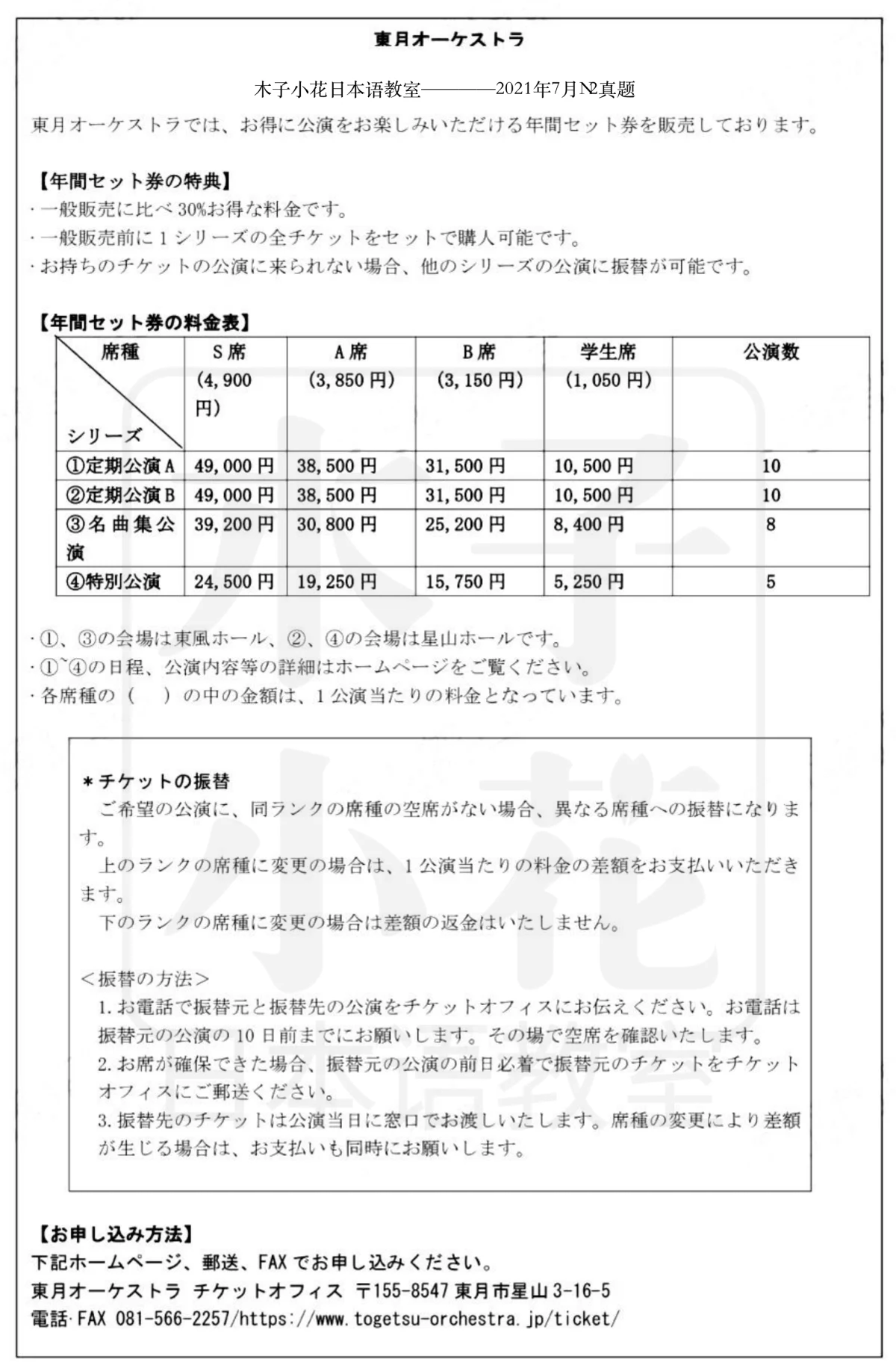
-
68.会社員のイリヤさんは年間セット券を購入することにした。星山ホールで行われるシリーズで、40,000円以内のものがいい。そして、公演数ができるだけ多く、席種はランクが高いものがいいが、ランクより公演数を優先したい。イリヤさんはどの年間セット券を購入するか。
Show answer
Answer: 2. ②のA席
条件の絞り込みfilter by 会場, 料金, 公演数, with count prioritized over rank
The line "①、③の会場は東風ホール、②、④の会場は星山ホールです" limits the choice to ② and ④. Within 40,000円, ② allows A席 at "38,500円" for 10 performances, while ④ allows S席 at "24,500円" for 5 performances. Since the question says "ランクより公演数を優先したい", the 10-performance option ②のA席 wins despite its lower rank.
Remember
For multi-condition questions, filter step by step in the stated priority order. Do not let a higher rank or lower price override a higher-priority condition like venue or count.
Why not the others
Words
- 席種seat type, seat category
- 公演数number of performances
- 優先priority, preference
-
69.スマンさんは「④特別公演」の年間セット券(A席)を持っている。来月10月23日の公演のチケットを「③名曲集公演」の10月30日の公演(A席)に振り替えたい。いつまでにチケットオフィスに電話しなければならないか。また、席が確保された場合、電話のあとどうしなければならないか。
Show answer
Answer: 1. 10月13日までに電話し、10月22日必着で振替元のチケットを郵送する。
振替元 vs 振替先deadline counts from the original, pay only if rank changes
The rule "お電話は振替元の公演の10日前まで" counts from the original, so 10 days before Oct 23 is Oct 13. The rule "振替元の公演の前日必着で振替元のチケットをチケットオフィスにご郵送ください" requires arrival by Oct 22. The change is from A席 to A席, so no extra payment is needed because payment applies only when "席種の変更により差額が生じる場合".
Remember
Always separate 振替元 (original) from 振替先 (destination). Deadlines and mailing dates follow the original, and choices using the destination date are a common trap.
Why not the others
Words
- 振替transfer, exchange
- 必着must arrive by
- 差額price difference
- 席種seat type
Listening 58 min · 34 questions
問題1課題理解Task comprehension
問題1では、まず質問を聞いてください。それから話を聞いて、問題用紙の1から4の中から、最もよいものを一つ選んでください。
-
1番
Show answer
Answer: 3. 当日、劇場の券売機で
-
2番
Show answer
Answer: 4. カード再発行の申込書に記入する
-
3番
Show answer
Answer: 4. サークルで新しい取り組みを提案する
-
4番
Show answer
Answer: 2. 毎日の売り上げの計算
-
5番
Show answer
Answer: 4. 食器の洗い方
-
6番
Show answer
Answer: 3. 論論文を読んで、わからない言葉を調べる
問題2ポイント理解Key-point comprehension
問題2では、まず質問を聞いてください。そのあと、問題用紙のせんたくしを読んでください。読む時間があります。それから話を聞いて、問題用紙の1から4の中から、最もよいものを一つ選んでください。
-
1番
Show answer
Answer: 4. 素材が今の流行と違うから
-
2番
Show answer
Answer: 3. 発想が豊かで、チャレンジ精神がある人
-
3番
Show answer
Answer: 3. カメラの角度や対象との距離を変える
-
4番
Show answer
Answer: 2. 包み紙が悪かったこと
-
5番
Show answer
Answer: 2. 新しい方針によって、収入が減ることをなげいている
-
6番
Show answer
Answer: 4. 前半、ペースを上げずに走ったこと
-
7番
Show answer
Answer: 1. 細かく時期に合わせて商品を出したほうがいい
問題3概要理解Gist comprehension
問題3では、問題用紙に何も印刷されていません。この問題は、全体としてどんな内容かを聞く問題です。話の前に質問はありません。まず話を聞いてください。それから、質問とせんたくしを聞いて、1から4の中から、最もよいものを一つ選んでください。
-
1番
The 4 choices are spoken, not printed. Listen, then pick a number.
Show answer
Answer: 1.
-
2番
The 4 choices are spoken, not printed. Listen, then pick a number.
Show answer
Answer: 4.
-
3番
The 4 choices are spoken, not printed. Listen, then pick a number.
Show answer
Answer: 3.
-
4番
The 4 choices are spoken, not printed. Listen, then pick a number.
Show answer
Answer: 2.
-
5番
The 4 choices are spoken, not printed. Listen, then pick a number.
Show answer
Answer: 3.
-
6番
The 4 choices are spoken, not printed. Listen, then pick a number.
Show answer
Answer: 3.
問題4即時応答Quick response
問題4では、問題用紙に何も印刷されていません。まず文を聞いてください。それから、それに対する返事を聞いて、1から3の中から、最もよいものを一つ選んでください。
-
1番
Show answer
Answer: 3. 何、どうしたの?
-
2番
Show answer
Answer: 1. あっ、はい、すみません。
-
3番
Show answer
Answer: 3. ああ、約束キャンセルしなくちゃ。
-
4番
Show answer
Answer: 1. うん、構わないよ。何?
-
5番
Show answer
Answer: 2. テニス始めたばかりなんだね。
-
6番
Show answer
Answer: 2. とても気に入ったわ。
-
7番
Show answer
Answer: 2. 人通りも多いのに、どうしてないのかなあ。
-
8番
Show answer
Answer: 3. うん、問題ないですよ。
-
9番
Show answer
Answer: 2. えっ、たとえば、どんなことをいうの。
-
10番
Show answer
Answer: 2. そうだね、目新しい感じはしないよね。
-
11番
Show answer
Answer: 2. じゃあ、お願いできる。
-
12番
Show answer
Answer: 1. お役に立てて何よりです。
-
13番
Show answer
Answer: 1. うん、食べた気がしないね。
問題5統合理解Integrated comprehension
問題5では、長めの話を聞きます。この問題には練習はありません。メモをとってもかまいません。
-
1番
The 4 choices are spoken, not printed. Listen, then pick a number.
Show answer
Answer: 3.
-
2番
Show answer
Answer: 2. 山田えり子氏
Explanations are AI-generated and are sometimes not accurate. Spotted a mistake in a question or answer? Write to us at hello@practicejlpt.com and we’ll fix it.